Archive for October, 2011

Big Fish out of Water

Friday, October 28th, 2011 by Ron

Sea Dragon is now deep into her heavy maintenance and overhaul cycle. Dale has just moved the boat down to Baja Naval…a well know yard in Ensenada Mexico. Here we start seeing some of the most fundamental… and really cool refit work.

Ensenada3

After almost 35,000 miles of heavy sailing and research work, covering four oceans and ports in four continents she is setting down for much deserved overhaul work. In Ensenada, the underwater hull will be cleaned, fared and repainted with anti-foul (we use a special water based paint that is much less risky for the environment. This makes the hull cut a clean, smooth…and fast shape in the water.

The above water sections will be repainted a luminous Navy Blue – Sea Dragon’s trademark color. The topsides will be stripped clean and repainted with a new anti-slip work surface. Down below, the bilges get a detailed inspection, corrosion check and repainting. Unlike the connotation of “bilge” it is vital that we keep Sea Dragon super clean. The bilge is the interior skin of the boat, it is the hull and our buoyant shield against the very deep seas we cross.

Stand by for more…

A note from Skipper Clive Cosby

Monday, October 24th, 2011 by Emily
After a whirlwind week following the development of an idea with a friend I find myself enrolled, active and catching-up with my fellow students on the inaugural Circular Economy PG Certificate course, exciting times. The course run by the University of Bradford in partnership with the Ellen MacArthur Foundation is an introduction to the principles and application of the ‘circular economy’.
> My inspiration to reach this point has mostly come from recent years having worked with, managed and lead teams of scientists, journalists, volunteers, educators and activists offshore voyaging into the ocean Gyres (accumulation zones) researching plastic. Our findings have been quite a revelation.
> Anything plastic released into the environment be it through landfill, littering, dumping, wind blown, even inadvertently discarded can, and invariably does end up in a water course, all courses lead downhill, down stream to the ultimate dumping ground – out of sight out of mind, the ocean.
> Despite their enormity and seeming endlessness they are not infinite. Over two-thirds of the surface of the planet is ocean and it is such a vital factor in our survival here on earth, and yet we still know so little about it. Species are still being discovered, more people have been into space then have visited the bottom of the ocean and we are still unsure as to the mating behaviour or breeding grounds of the largest animal ever to have roamed our planet – the Blue Whale.
> Technological advances abound and yet nature still holds so many secrets. One thing we do know is that our impact away from land is far reaching and negative on this vital beautiful wilderness.
> In the environment plastic fragments and photo-degrades (breaking down in many pieces). Uniquely unlike glass, wood, metals, card and paper which (in their simplest form) will go back into the earth it does not bio-degrade, in effect everything plastic ever produced is still out there. Recycling rates whilst increasing are still low. Concerningly there is growing evidence that fish are consuming plastic which is known to absorb harmful chemicals such as POPs, banned in the world today. We eat the fish.
> And so here I am embarking on a fantastic opportunity to learn more about the Circular Economy model, look at ways of applying it to the plastic issue, develop workable solutions and partnerships with manufacturers, scientists, policy makers and stakeholders. I will also be continuing to raise awareness on the (often) unnecessary use and wasteful disposal of this finite resource in new and engaging ways.A view of the ocean from on board. Photo C.Box
> Watch this space for developments and keep in touch with ideas.
> Clive

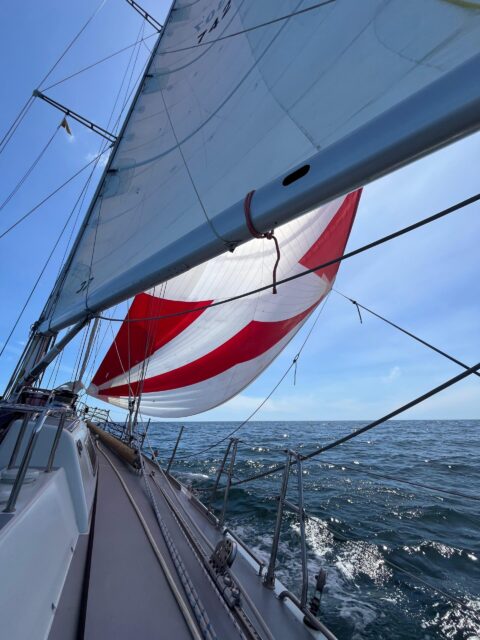
A view of the ocean from on board. Photo C.BoxAfter a whirlwind week following the development of an idea with a friend I find myself enrolled, active and catching-up with my fellow students on the inaugural Circular Economy PG Certificate course, exciting times. The course run by the University of Bradford in partnership with the Ellen MacArthur Foundation is an introduction to the principles and application of the ‘circular economy’.

My inspiration to reach this point has mostly come from recent years having worked with, managed and lead teams of scientists, journalists, volunteers, educators and activists offshore voyaging into the ocean Gyres (accumulation zones) researching plastic. Our findings have been quite a revelation.

Anything plastic released into the environment be it through landfill, littering, dumping, wind blown, even inadvertently discarded can, and invariably does end up in a water course, all courses lead downhill, down stream to the ultimate dumping ground – out of sight out of mind, the ocean.

Despite their enormity and seeming endlessness they are not infinite. Over two-thirds of the surface of the planet is ocean and it is such a vital factor in our survival here on earth, and yet we still know so little about it. Species are still being discovered, more people have been into space then have visited the bottom of the ocean and we are still unsure as to the mating behaviour or breeding grounds of the largest animal ever to have roamed our planet – the Blue Whale.

Technological advances abound and yet nature still holds so many secrets. One thing we do know is that our impact away from land is far reaching and negative on this vital beautiful wilderness.

In the environment plastic fragments and photo-degrades (breaking down in many pieces). Uniquely unlike glass, wood, metals, card and paper which (in their simplest form) will go back into the earth it does not bio-degrade, in effect everything plastic ever produced is still out there. Recycling rates whilst increasing are still low. Concerningly there is growing evidence that fish are consuming plastic which is known to absorb harmful chemicals such as POPs, banned in the world today. We eat the fish.

And so here I am embarking on a fantastic opportunity to learn more about the Circular Economy model, look at ways of applying it to the plastic issue, develop workable solutions and partnerships with manufacturers, scientists, policy makers and stakeholders. I will also be continuing to raise awareness on the (often) unnecessary use and wasteful disposal of this finite resource in new and engaging ways.

Watch this space for developments and keep in touch with ideas.

Clive

Putting the Sherwood Regs to work in caves

Monday, October 17th, 2011 by Ron

With Sea Dragon parked quietly in and all in pieces (Dale!) for her refit, the Pangaea team is satisfying their water needs in other places. One of us recently had a chance to run a series of cave dives in Central Florida, and then the awesome underwater-underground land of Mexico’s Yucatan.

Yucutansmall

Cave represent a distinctly alien habitat for our ocean going vessel Sea Dragon – for obvious reasons. The vast majority of explored caves are vast systems of landlocked fresh water with little access to the sea. They are also what we call “overhead” environments- with no direct access to the surface.

Water cave systems are, however, an area of interst for our team given their unique biodiversity and often critical conservation concerns. Here in Florida, Pangeas home base, the region is home to one of the highest concentrations of “karst” systems. Significant spring and sinkhole sytems exists principally in the north central part of the state. Often ranging several miles laterally and 100+ feet below surface, they are an integral part of the regions water supply. They are also home to several unique species. Several of Pangaea’s team have explored regional caves. One really strking example is “Eagle’s Nest” in Citrus County. Miles from any paved road, an incredbily ordinary looking pond opens through a short shaft into the ceiling of a room large enough to park a Boeing 747 airliner. Super clear water extends off two main passages to deep tunnels ove 400′ deep.

We have also had a recent, short visit to the exceptional caves of the Yucatan. Here surface holes in the limestone rock, punch a short distance into elaborate systems. These caves, unlike those in Florida, formed with extensive dry phases. This critical difference means they now have fantastic karst features called “speleothems” – or cave formations. Stalactictes, stalagmites, flowstones and even helictites absolutely cover interior surfaces. Also, due to their dry phases, the contain extensive fossil and pre-historic human artifacts. They are also, unlike Florida caves, remarkably shallow.

In both cases, we have made great use of our Sherwood regulators – and appreciate their continued support. The best test was the smooth breathing of the SR1 at 230′ in Eagle’s Nest. This mixed gas dive gave us alot of confidence.

Tracking the Debris from Japan’s Tsunami

Wednesday, October 12th, 2011 by Emily

Article from The New York Times on Wednesday October 12th 2011

Full article available here: http://green.blogs.nytimes.com/2011/10/12/tracking-the-debris-from-japans-tsunami/

Tracking the Debris from Japan’s Tsunami

Just over six months have passed since a huge tsunami slammed into northeastern Japan, killing thousands of people and wrecking towns and villages along the coast.

The devastation on land was terrible, but the disaster also left a mark on the ocean that generated the tsunami: tens of thousands of tons of debris, including entire houses, cars and boats, were swept out to sea that day. This mass has now dispersed over an area covering several hundreds of miles in the northern Pacific Ocean.

Now scientists from California are inviting the public to join them on aresearch trip into the debris field next May and June.

The 7,000-mile research voyage is being organized by the 5 Gyres Instituteand the Algalita Marine Research Foundation, two nonprofit groups that campaign against plastic pollution, in collaboration with Pangaea Exploration, which operates an expedition vessel known as the Sea Dragon. The boat will sail from the Kwajalein Atoll in the Marshall Islands to Japan and then on to Hawaii.

Nine crew spaces are available on the Sea Dragon for each of the two legs of the voyage, at a cost of $13,500 per person for the first leg and $15,500 for the second, to help finance the expedition.

The scientists’ goal is not just to get a clearer idea of the sheer amount of trash in the ocean and the speed at which it is dispersing, but also to monitor how quickly the debris is being colonized by marine life and whether it is transporting invasive species, Marcus Eriksen, the expedition leader, said by phone from Los Angeles.

This could help them assess whether the debris could ultimately travel as far as the West Coast, Mr. Eriksen said. For now, Hawaii is expected to bear the brunt of the traveling debris.

Even if it does not journey as far as the West Coast, the debris will not simply disappear. Items made of non-decomposing materials like plastic crates, building insulation, furniture and everyday household items — will keep traveling the oceans, probably for years, joining the mass of plastic trash that has been accumulating there for more than a half century.

In essence, as devastating as it was, the March 11 tsunami affords a unique opportunity for studying the phenomenon of marine pollution. After all, rarely are such huge amounts of debris swept simultaneously into the ocean from a single location.

No previous seafaring experience is necessary to join the trip. You do, however, have to be prepared to earn your keep, whether by hoisting sails, hauling lines or cataloging samples. “It’ll be all hands on deck,” said Mr. Eriksen, who is also executive director of the 5 Gyres Institute.

The results should be published within about three months after the group wraps up its trip, Mr. Eriksen said. Watch this space.

Sea Dragon Heavy Maintenance

Thursday, October 6th, 2011 by Ron

Sea Dragon in San Diego

Sea Dragon in San Diego

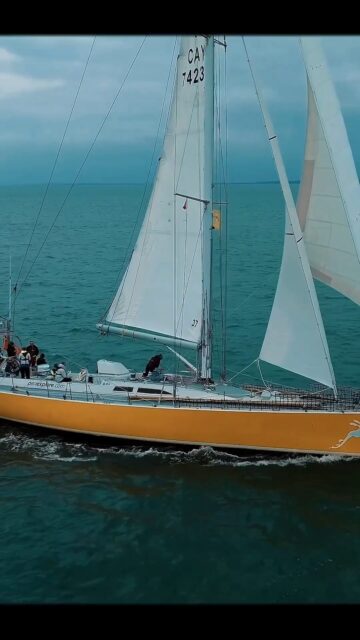
Like commercial airplanes, ships and big trucks, Sea Dragon is a complex machine that deserves alot of careful attention. Operating in tough, remote and unforgiving environments she needs go for months on end, keeping her crew safe and productive. Part of making this possible, is her exceptional design and on board crew. This rugged, capable boat has delivered flawlessly for over 35,000 miles in three oceans in just the last 18 months alone. Her crew, led by Dale, Clive and Emily have been a big part of making this work. We follow a simple motto 24/7 in any ocean: Protect the Boat, Care for the Crew, and Be Productive.

An important part of this is the periodic “heavy” maintenance and refit work we do in select ports. The first, of course was the 8 months we spent back in the UK in 2009. The next major stop was South Africa in late 2010 when we pulled the mast and totally rebuilt the sailing rig – a huge job that is essential to the power and safety of the boats main engine….her sails. Now, in San Diego California we have begun the next major phase of refurb and refit. This is about catching up on wear and tear first. Second we look at ways to streamline and simplify the boat systems – further increasing their reliability and efficiency. Finally there are several important upgrades that will make Sea Dragon – already one of the world’s most capable expedition yachts, even more mission ready.

Our good friends Kevin and Colleen Ryan at Outbound Yachts in Dana Point CA are leading this important work. We’ve know Outbound for many years and trust them to our most critical work. In our view, you will find no better team to hande this type of work ( Outbound Yachts )

In the first group there are important tasks that keep us running well. Out of the water, her hull will be smoothed down and painted with a super low toxicty “anti foul” paint that keeps a clean fast shape in the water – and a minimum of chemicals in the water. The side hull will be repainted a shiny new color (looks do count :) ), and the top decks will be repainted to renew her anti-slip work surfaces. Bilge steel is cleaned an cleared of rust. The main engine and generator are set to get major overhauls that increase reliability and also decrease fuel burn. Lines and rigging are being redone – with some exciting new technology we wil reveal at a later date.

In the second, we are adding a new in-board freezer system, removing a bulky,smoky diesel heaters, and re-doing much of the fuel systems. Exciting for the working 14 person crew, all bunks will now have a/c and 12V dc power – you cannot believe what a huge deal this is for the laptop that used to lie all over the boat. The boats vital navigation systems are being upgraded with a new Furuno NAVNET 3D main display. this will take the prior laptop computer out of the loop – also saving power. New battery chargers – very advanced versions of what you might use on a car, will dramatically increase our ability to recharge main batteries- and therefore save fuel. A new 400′ (130m) anchor chain increases our safe anchor depth to over 100′. We are adding purpose built storage space to tighten up space on the boat. Most important for some….two advanced air conditioning units will be on board that allow us to heat, cool and dry air inside the boat- very important in the tropics!

The latter category of major capability upgrades holds a few very important items. Foremost, Sea Dragon’s entire stern section is being redesigned to create a working platform, new hoists and much, much easier access to overboard diving and work. Originally set up for intense offshore racing, she will now be much better suited to the expedition and research work we do.

This work is underway – stand by for more updates and photos!